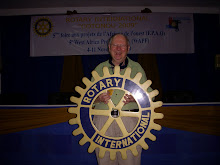
Polio Plus, takes on a whole new exciting meaning, as one stands in an African village, 'frying' in the heat and placing 2 drops of vaccine on a quivering tongue!
Last November, I headed to Cotonou, Benin, in West Africa, via Paris. 38 Rotarians, representing 32 clubs, from 21 districts, took part in the event. Local Rotarians and health workers, worked with us, to give vaccine to 3,313 children, under 5. Some of us headed out to distant villages, on motor bikes. Chalk strokes on the clay hut walls, recorded our visit. A black magic marker, was used to paint the nail of the baby finger on their left hand, before we moved on to the next infant.
Another important proceeding, was our attendance at the 5th Annual Project Fair with representatives from five different West African nations � Benin , Togo , Nigeria , Ghana and Cote d�Ivoire , representing 48 different Rotary clubs. We estimate that there were 240 different projects offered, worth an estimated value of more than $2.5 million. Information, will be made available at our district conference, if your club wishes to 'team up' with an African club.
The last highlight, was a visit to a Mercy Ship. Over 40 doctors, complete 7,000 surgeries a year. Also, we learned about their programs on land, with health, education, water and agriculture.
Polio Eradication Realistic Decades ago, polio outbreaks were a constant threat around the world. After the introduction of polio vaccines by Jonas Salk and Albert Sabin and a steadfast immunization effort, these outbreaks became part of history in most of the world. Yet many still live under the threat of polio, which is why Rotary and its global partners are committed to reaching every child with the vaccine and ending this disease worldwide. Major gains have been made in the global fight against polio: • In the 1980s, 1,000 children were infected by the disease every day in 125 countries. Today, polio cases have declined by 99 percent, with fewer than two thousand cases reported in 2006. • Two billion children have been immunized, five million have been spared disability, and over 250,000 deaths from polio have been prevented Rotary will continue the fight until the world is certified polio-free and every child is safe from this devastating disease. PolioPlus: Rotary's Top Philanthropic Goal is to End Polio Worldwide. • Polio, a crippling and sometimes deadly disease, still threatens children in parts of Africa and Asia. • Rotary members have donated their time and money to help immunize more than 2 billion children in 122 countries. • Rotary is the largest private supporter of the Global Polio Eradication Initiative, committing more than $600 million dollars and thousands of volunteers to the effort. • For as little as 60 cents worth of oral polio vaccine, a child can be protected against this crippling disease for life. Tremendous Progress has been made toward ending Polio worldwide. • In the 1980s, about 1,000 children were infected by this crippling disease every day. • In the two decades since Rotary and its global partners launched the Global Polio Eradication Initiative, polio cases have been slashed by 99 percent. Did you know the Rotary Polio Plus program began in the Philippines? In 1983 the Rotary Club of Mabalacat under President Bruce McTavish conducted a comprehensive drive that immunized thousands of children in Mabalacat, a city in the province of Pampanga, one hundred kilometers north of Manila. With the success of that initial drive, plans were made for future immunizations in later years. In 1985 Rotary International announced its polio plus drive signaling the beginning of a worldwide effort. In 1986 RI finalized their project plans and Angeles City/Mabalacat was selected as a pilot area for polio plus in the Philippines. On Sunday morning, February 15, 1987, workers at Mabalacat hospital began assembling the drug packets that would go with each of the eighteen teams to thirty immunization sites. Each team consisted of one Rotarian, several midwives, student nurses, & barangay health workers. Each team leader had been briefed in advance, received maps directing him to his barrio and had visited the site to insure all was ready. Now, nearly twenty years later, the world has only a few places in which the dreaded disease of polio still exists. ==============================
Past President
PHF
30 yr.member
Youth Exchange Officer 7 yr.
Bulletin Editor 15 yr.
Past District Chair - Fellowships
Winner of Best District Electronic Newsletter
Has attended Rotary meetings in 9 countries
Editor of Jocoe's Journal
Charter member: ROTI
Charter member & Past chair of Rotary Editors & Publishers